.png?width=4758&height=806&name=Frame%202131330738%20(1).png)

Telegram Ads


Visibility has become the biggest challenge in online advertising today. Users are exposed to thousands of ads every day, yet most go completely unnoticed due to banner blindness, a widely recognized behavior where people instinctively ignore traditional ad types. In this guide, you’ll learn why banner blindness happens, how it can damage your ROI, and what strategies work today to win back attention and drive real engagement.
When people browse online, they have a goal. For instance, they may be researching a solution, comparing tools, or reading resources to solve a problem. Their brain filters out anything that doesn’t help them get there, such as banner ads. Over time, people become even more efficient at ignoring banner-style formats. The more often they see similar layouts, colors, and placements, the faster their brain dismisses them. That’s why over 80% of users completely ignore banner ads, which creates a growing challenge for both publishers and advertisers.
What’s even more interesting is what customers tend to ignore first. Research using eye-tracking studies shows that people instinctively skip over the top banner area, sidebars, and anything that looks like a traditional display ad. These sections have become known as “banner zones.” Users often don’t even register them consciously. Their eyes move straight past these areas toward the main content, especially text-heavy sections that feel more relevant to their goal.
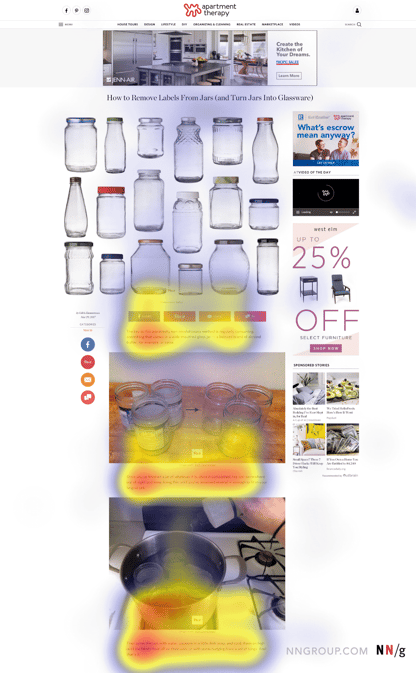 Research shows people focus heavily on the main text, while top banners and right-side ads receive minimal focus. Source: Nielsen Norman Group
Click-through rates on traditional banner ads have been declining for years. Many campaigns struggle to reach even a fraction of a percent. That means your ads are technically being served, but not truly seen by your target audience.
Data backs it up. The average click-through rate for banner ads has dropped to around 0.05% — a sharp decline from the early days of online advertising, when CTRs often exceeded 2%.
Even when you look at broader display ad performance, results are still underwhelming. Average CTRs typically range between 0.1% and 0.3%, depending on the industry and country.
What’s worse, poor user response sends negative signals back to ad platforms. When people consistently ignore your ads, algorithms interpret that as low relevance. Over time, this can increase your costs and limit your reach, which creates a frustrating cycle where you pay more for weaker results.
Let’s explore the most effective strategies to overcome banner blindness and drive more meaningful ad performance.
Consumers tend to ignore ads because most of them feel irrelevant to their needs or interests. And when an ad directly addresses their needs, their attention shifts immediately. Instead of thinking about placements first, think about context. What is your audience trying to achieve at that moment? What problem are they solving? What questions are they asking?
For example, messages like “Buy Crypto Now” feel too broad to stand out, so people typically scroll right past them. But a message that addresses a specific pain point, like “Tired of high transaction fees eating your profits?” or “Looking for a safer way to store your digital assets?”, is far more likely to cut through the noise and overcome banner blindness.
This requires a smarter approach to targeting and messaging. Broad campaigns might give you reach, but they rarely spark real interest. When you segment your audience and tailor your message to specific needs or pain points, everything starts to click. Your content feels more relevant, more timely, and far less intrusive, which is why strategies built around user intent consistently outperform generic approaches.
Personalized calls-to-action can outperform generic CTAs by up to 202%. Personalization doesn’t have to be complicated. Even small adjustments can make a big difference. Referencing industry, company size, or specific challenges can transform how people perceive your banner.
Behavioral data is key here, because it replaces assumptions with actual insight. Which pages have visitors explored? What has captured their attention? How deeply have they engaged, and where exactly are they in the funnel? These signals reveal intent far more accurately than demographics alone.
When behavioral data is applied well, advertising becomes more seamless. Instead of breaking the user’s focus, it aligns with their intent and feels like a logical next step in their journey rather than an interruption.
Native ads work because they don’t feel like ads at first glance. They blend into the surrounding content by matching the tone, style, and structure of the platform, which makes them significantly less intrusive. This matters because users are far more likely to engage with promotions that feel contextual rather than disruptive. In fact, this type of ads generate 53% more attention, precisely because they don’t trigger the same “avoidance” response as banner formats, which is also why publishers increasingly prioritize native placements in their monetization strategies.
Each native ad format serves a different purpose depending on the platform, audience behavior, and campaign goal, but they all share one core principle: they mirror the environment they appear in.
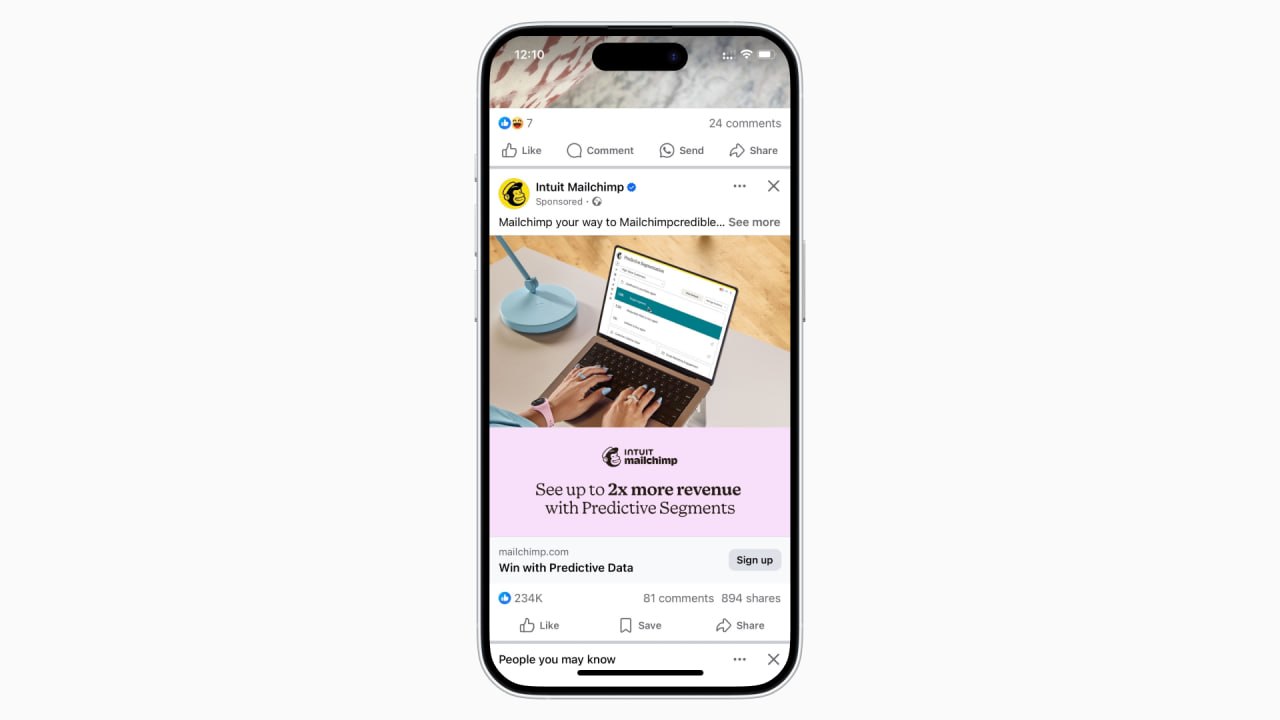 A Facebook ad in a feed
Among these, in-feed native ads typically generate the highest revenue share, largely because they integrate seamlessly into update streams where user attention is already active.
Optimize Ad Placement, Design, and Frequency
As mentioned before, certain areas of a webpage have become “banner zones”, or places users instinctively ignore. Sidebars and header strips often fall into this category. Shifting your ads into less predictable positions can improve visibility. In-content placements, for example, tend to capture more attention because they align with the reading flow.
.png?width=1920&height=1080&name=Screen_2%20(1).png) Example of an in-text ad placement
Example of an in-text ad placement
Avoid overly polished, sales-heavy visuals. Ads that look too much like promotions are the easiest to ignore, which is why publishers often favor more native-looking creative approaches. Instead, aim for a more natural aesthetic. Use clean layouts, subtle colors, and clear messaging.
Frequency is another balancing act. If people are exposed to your ads too often, ad fatigue sets in and attention quickly drops. If exposure is too limited, you risk losing visibility and missing key opportunities to stay top of mind. With thoughtful frequency capping, you can keep visibility consistent while avoiding repetition that turns audiences away.
Telegram, now the second most popular messaging app globally, offers a completely different environment compared to traditional display networks, and that’s why it supports more effective strategies for overcoming banner blindness.
Instead of competing on cluttered webpages filled with banners and sidebars, Telegram Ads appear directly within private and public channels and bots where people are actively engaged and spend an average of over four hours each month. There are no familiar “banner zones” for users to instinctively skip. The experience is more linear and less distracted, which changes how attention is distributed. As a result, ads are more likely to be noticed because they exist within the natural flow of content rather than being placed on the sidelines.
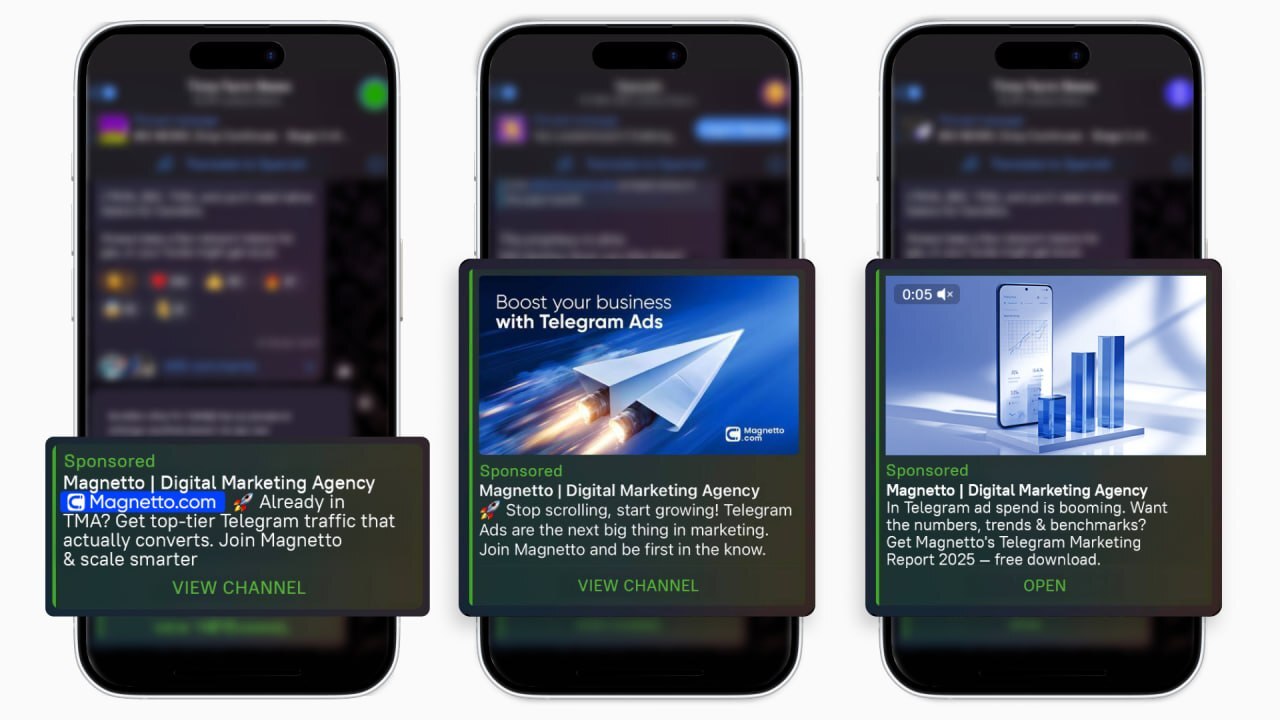
Telegram Ads
Another advantage is intent-driven exposure. Telegram channels are often niche and topic-specific, which means users have already chosen to follow content aligned with their interests. When ads appear in this context, they feel more relevant by default, which increases the chances of interaction without relying on overly aggressive design or intrusive placements.

Telegram mini apps open up another layer of opportunity. These lightweight, in-app experiences, used by over 500 million people each month, allow brands to go beyond simple ad placements and create interactive touchpoints directly within Telegram. Instead of simply capturing attention, you can invite visitors to actively engage, such as completing a task or interacting with a game.
TMA Ads also offer strong targeting capabilities, including Wallet holders, device type, Premium subscribers, geographic location, and languages. With average click-through rates of around 5%, TMA Ads significantly outperform most traditional online advertising formats.
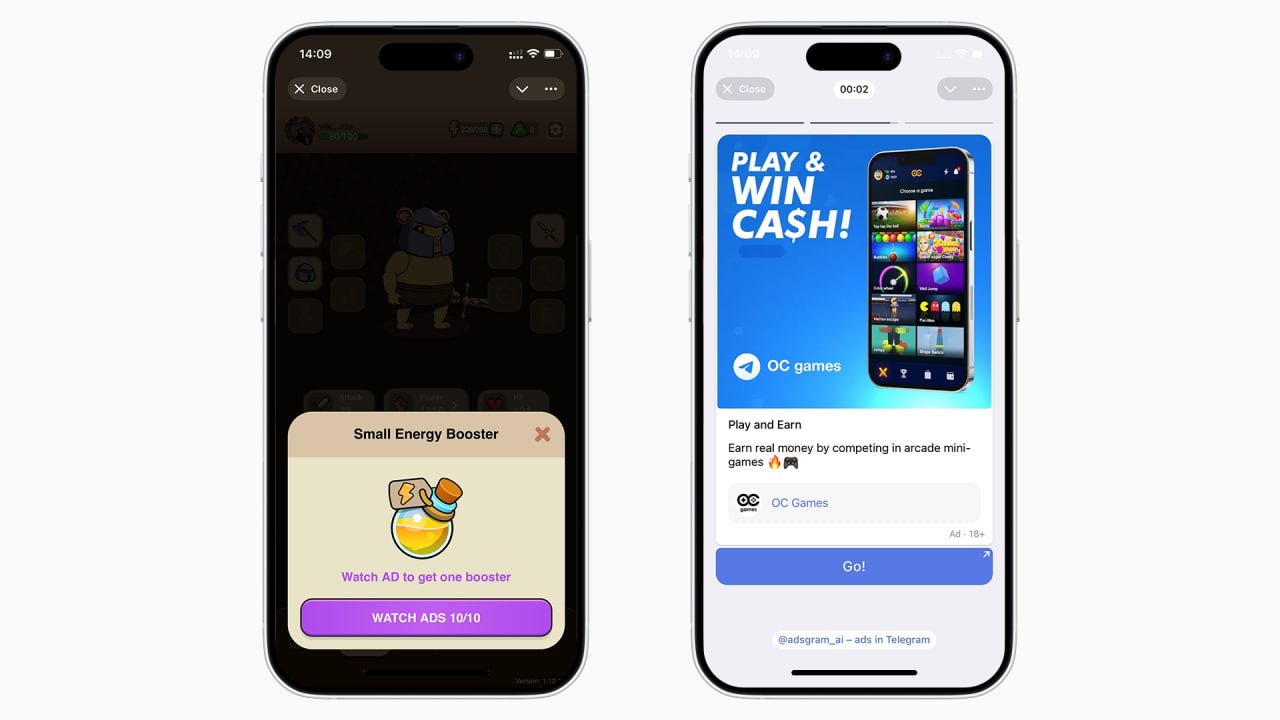 Telegram mini app ads
Telegram influencer marketing has become one of the most effective strategies on the platform to increase visibility and build trust. Attention on Telegram is highly trust-driven. People don’t casually scroll through random feeds; they actively subscribe to channels they find valuable. When an influencer recommends a product, service, or tool, it feels more like a personal endorsement than an advertisement. In fact, when it comes to trust on Telegram, 73% of users say they rely on specific public authors.
This trust plays a direct role in overcoming banner blindness. Since influencer posts are delivered in a familiar voice and within a trusted channel, they don’t trigger the same automatic filtering that audiences apply to traditional ads. There are no visual cues that signal “this is an ad” in the same way as banners or display types. Instead, the message blends into the posts subscribers are already engaged with, which makes it far more likely to be read, considered, and acted on.
Banner blindness isn’t a design problem as much as it is a behavioral one: consumers have simply learned to filter out anything that feels like an interruption. The good news is that attention hasn’t disappeared. It has just become more selective. People still engage with ads online, but only when they feel relevant, timely, and naturally placed within their experience, making both advertisers and publishers rethink traditional approaches and adopt more effective strategies. Ultimately, overcoming banner blindness comes down to one principle: meeting your target audience where they already are, with messages that genuinely matter to them.