Customer acquisition costs have been rising steadily across social media advertising. At the same time, ongoing changes in privacy regulations and platform policies have made it harder to track and measure audiences accurately. For FMCG brands, this creates a clear challenge: it’s becoming harder to grow steadily over time. They can no longer depend on a single platform or paid channel, especially when visibility, data access, and performance can change quickly.
This is why more businesses are starting to look beyond traditional channels and focus on building something they can control directly. Creating an owned audience, especially through social platforms like Telegram, is an effective way to maintain long-term engagement, grow stronger customer relationships, and reduce dependency on paid media.
In this article, you will learn why growth on mainstream platforms like Meta is becoming less effective, how owned audiences create more control, and how Telegram helps FMCG brands build stronger engagement and long-term customer relationships.
Why Brands Can No Longer Rely Only on Meta to Grow Consistently
Let’s look at why the traditional ways FMCG brands use to grow are becoming less effective.
Rising CPMs
For years, Meta served as the default growth engine for FMCG brands. However, the platform has become increasingly competitive and expensive. Attracting new users now costs significantly more than it did just a few years ago. Increasing CPA rates across major FMCG categories show that brands are paying more to achieve the same results:
- Health & Wellness: +12.64% YoY
- Beauty: +3.94% YoY
- Home & Garden: +4.08% YoY
As more businesses compete for the same audience attention, advertising inventory becomes more expensive while engagement efficiency declines.
Privacy Changes and Weaker Targeting Signals
One of the biggest turning points came when Apple introduced App Tracking Transparency (ATT). Apps had to ask users for permission before tracking their activity across other apps and websites. Most users declined. Some estimates place global opt-in rates below 30%, which means advertisers instantly lost visibility into a huge portion of mobile behavior. This hit platforms like Meta especially hard because its advertising systems rely heavily on behavioral signals. With less user-level data available, retargeting becomes weaker, attribution becomes less accurate, and lookalike audiences lose efficiency.
At the same time, browser privacy restrictions created another layer of disruption. Safari and Firefox already block many third-party tracking methods by default, while Chrome spent years attempting to phase out third-party cookies through its Privacy Sandbox initiative. Even though Google later adjusted its approach, the direction of the industry is clear: privacy-first advertising is becoming the standard.
Risks of “Borrowed Audiences”
Just because you have many subscribers, strong engagement, or solid content and ad performance on social media doesn’t mean you actually own your audience. In reality, those relationships belong to the platform first, not to your business.
That’s what makes borrowed audiences so risky. When your entire growth strategy depends on platforms like Meta, you’re building your business on rented land. The platform controls the algorithm, the visibility, the data, and ultimately the connection between you and your audience. And those rules can change overnight. A small algorithm update can suddenly reduce your organic reach, or rising ad costs can make customer acquisition far more expensive than it was before.
How an Owned Audience Can Help Your FMCG Brand Grow
Instead of depending entirely on external platforms, more and more FMCG brands start building communication channels they can actually control. That includes email subscribers, SMS databases, Telegram communities, loyalty-program members, and customer lists collected through first-party data campaigns. These audiences are “owned” because the relationship belongs directly to the brand, not to a social media platform or advertising algorithm.
An owned audience allows you to:
- Communicate directly with subscribers anytime
- Collect valuable first-party customer data
- Reduce dependency on rising ad budgets
- Personalize offers and communication more effectively
- Create a more predictable long-term growth strategy
That creates a major advantage in an industry like FMCG, where repeat purchases drive long-term revenue. A customer who buys once through an ad is valuable, but a customer who joins your ecosystem and stays connected over time becomes far more profitable. In fact, repeat customers can generate up to 3x more revenue than first-time buyers.
Telegram: an Ideal Platform for Building an Owned Audience
Today, Telegram is among the top three most popular messaging apps in the world, and more than 500 million people worldwide engage with the app daily. Beyond staying in touch with friends and family and consuming content, users are also doing things that most other platforms don’t fully support: they manage finances, trade crypto, book services, make purchases, interact with bots, play games, and more.
A typical Telegram user spends over 41 minutes a day on the app. Compared to around 141 minutes of total daily social media use, that means nearly a third of their attention is concentrated inside Telegram.
The core and most valuable FMCG segment, millennials aged 25–34, also represents a significant share of Telegram’s user base:
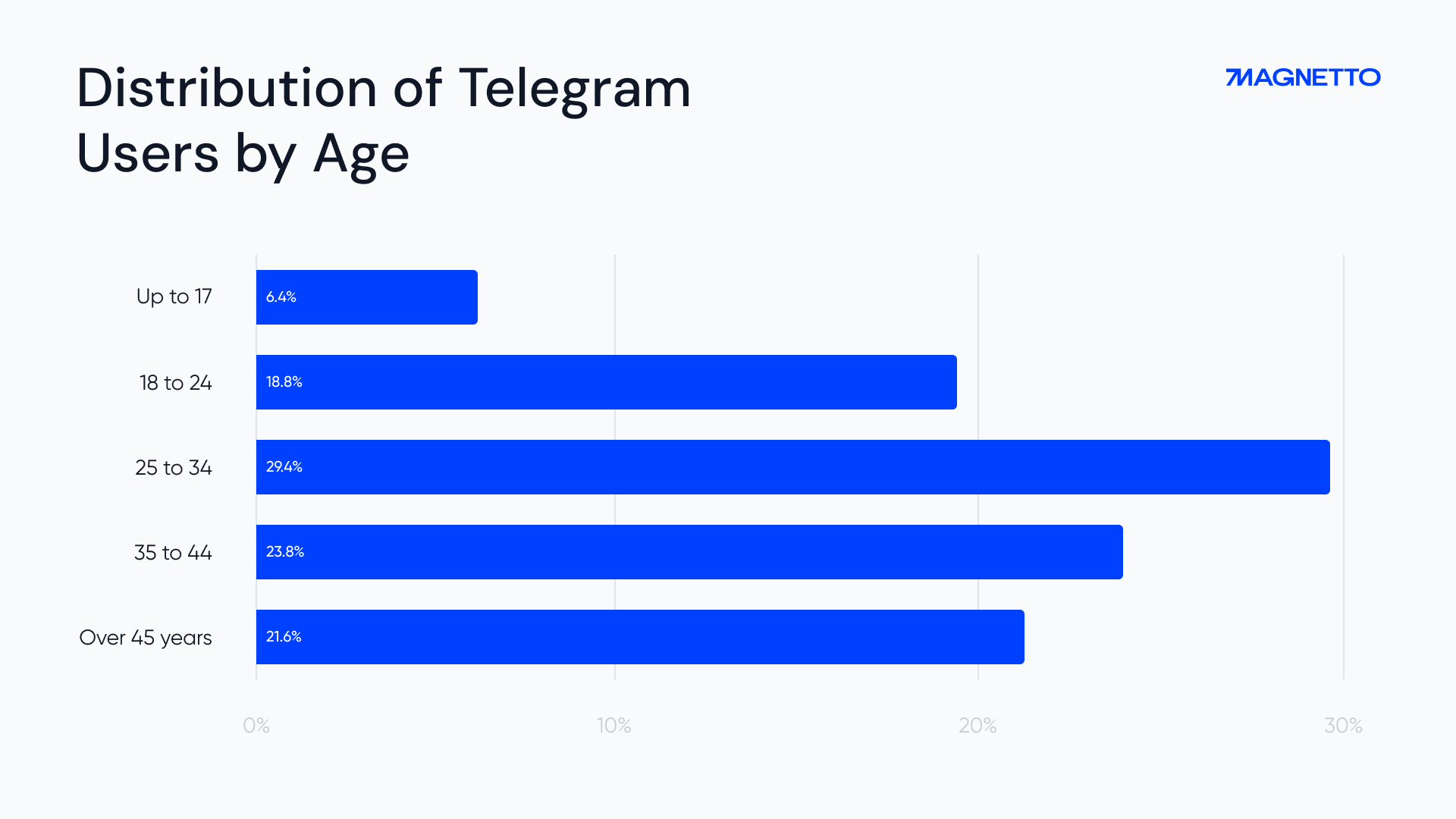 Distribution of Telegram users by age. Source: Telegram Marketing Statistics and Trends: The 2025–2026 Report
For 8 out of 10 users, Telegram is a primary source of news and updates. People who join Telegram communities are more intentional. They’ve opted in, they’re interested, and they are more likely to interact with updates, offers, and product news from brands.
How FMCG Brands Use Telegram to Build Engagement and Drive Retention
Telegram Channels for Valuable Content and Product Updates
Channels are the simplest way to keep your audience updated. FMCG brands can use them to inform their subscribers about new product drops, seasonal campaigns, limited editions, or retail availability updates. The key advantage is consistency. Once users join, your content goes straight to them every time, instead of being filtered by algorithms or unpredictable reach.
Telegram Bots for Promotions, Loyalty Campaigns, and Support
For FMCG brands, Telegram bots make it possible to move beyond simple announcements and create real participation. With bots, you can run quizzes, reward programs, cashback offers, and automated promo journeys that guide users step by step.
Around 80% of consumers are more likely to buy when brands deliver personalized experiences, and Telegram bots make it possible to deliver that level of personalization at scale. Bots can adjust messages, content, offers, and recommendations based on user behavior, preferences, or past interactions. One user might receive a cashback deal, another might get a product suggestion, and someone else could be invited into a loyalty flow.
Bots are also widely used for customer support. They answer common questions, share product details, help with orders, and solve basic issues instantly, even outside business hours. For teams, this kind of automation takes away a lot of repetitive work and frees them from handling the same routine questions over and over.
Telegram Mini Apps for Retention and Repeat Purchases
Every extra step in a customer journey increases the chance of drop-off, especially when it comes to how users move from discovery to purchase. Telegram mini apps allow brands to keep the entire experience inside the same environment where users are already active, so there is no need to switch platforms or download a separate app just to complete an order.
Telegram mini apps are lightweight applications that run directly inside Telegram. They behave like small websites or mobile apps, but they are fully integrated into the chat interface. Users can open them from a link, a button, or a bot, and immediately interact with features like product browsing, payments, loyalty programs, or reward tracking.
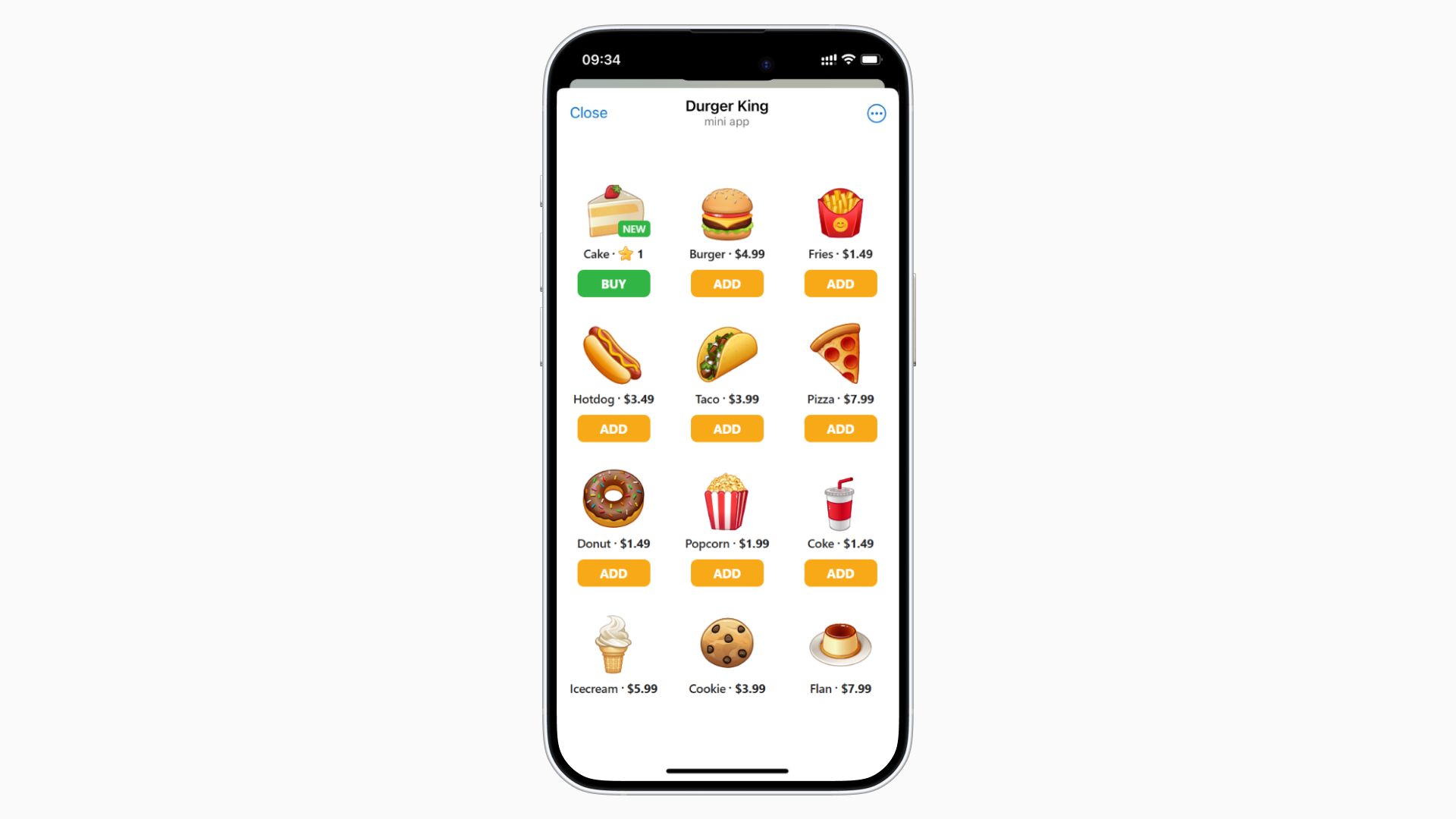 Durger King | Telegram Mini App
In practice, FMCG brands use Telegram mini apps for:
- Product catalogs with direct re-order options
- Digital loyalty cards and point tracking
- Cashback and reward redemption systems
- Gamified campaigns and seasonal challenges
- Personalized offers based on user behavior
Since more than 90% of users feel frustrated when asked to download a separate app just to complete a purchase, mini apps help FMCG brands keep the journey seamless and encourage more repeat purchases within Telegram.
Telegram Ads: Cost-Efficient Growth for FMCG Brands
As FMCG businesses move beyond dependency on Meta and other social media platforms, Telegram Ads are becoming an important part of the acquisition strategy.
Telegram Ads are typically shown as text-based banners inside popular public and private channels. Brands are not interrupting passive scrolling behavior in a feed. Instead, they appear within content that users have already chosen to follow. This creates a different type of attention, which is more intentional, more contextual, and more relevant.
.png?width=1920&height=1080&name=Telegram%20Ads%20examples%20(3).png) Telegram Ads
Telegram Ads
For FMCG brands, this matters because timing and context play a key role in purchase decisions. A well-placed ad inside a niche food, lifestyle, or deal-focused channel can reach users at the exact moment they are actively exploring ideas, products, or offers. In that setting, the message feels less like interruption and more like discovery, which naturally increases engagement and click-through rates.
Another important advantage is cost efficiency. Traditional platforms like Facebook Ads have become increasingly expensive: average CPMs reach $17 and CPCs average around $1. Telegram Ads, by comparison, perate at a significantly lower cost, which makes it possible to reach engaged audiences without the pricing pressure seen on more saturated platforms.
What also makes Telegram Ads powerful is what happens after the click. Brands can guide users directly into a Telegram channel, bot, or mini app. This creates a smoother journey from awareness to engagement and helps FMCG brands turn paid traffic into an owned audience they can keep building relationships with over time.
Wrapping Up
FMCG brands are focusing more on building direct relationships with customers instead of relying only on paid advertising. As acquisition costs keep rising and audience reach becomes less precise, it’s harder to get consistent results from ads alone. Owned audiences built through platforms like Telegram give brands a more stable way to stay connected with customers, maintain ongoing engagement with subscribers, and build long-term relationships that are not dependent on paid media performance.
.png?width=4758&height=806&name=Frame%202131330738%20(1).png)